22 Jan 2026 · sven@coursy.io
LMS ROI Timeline: What to Expect

Investing in a Learning Management System is a strategic decision — but when will you actually see the return? As an LMS buyer, you need realistic expectations backed by data, not vendor promises. Understanding the ROI timeline helps you build a business case, set stakeholder expectations, and measure the right things at the right time.
This guide breaks down what to expect quarter by quarter, what can delay your results, and how to keep your implementation on track.
Interactive calculator included
What you’ll learn:
- Realistic ROI timeline expectations quarter by quarter
- Key metrics to track at each implementation phase
- Common delays and how to avoid them
- How to build a compelling business case for stakeholders
How long until an LMS shows ROI?
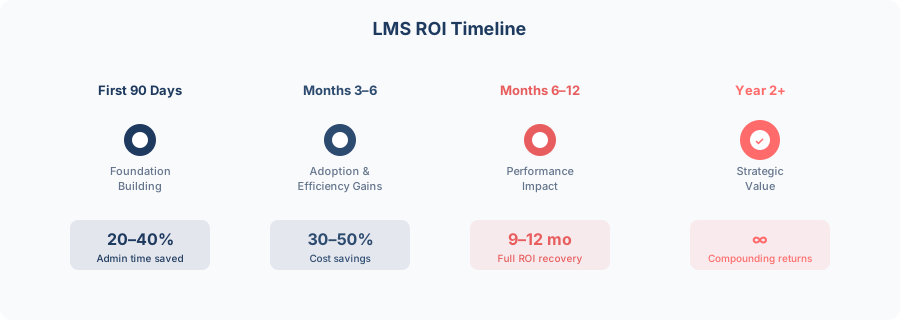
Most organizations recover the cost of an LMS within 9 to 12 months. Admin savings come first: a 20–40% drop in training administration time in the first quarter. Lower delivery costs follow in months three to six, and measurable performance gains arrive between months six and twelve. The rest of this guide breaks down each stage and what can slow it down.
The First 90 Days: Foundation Building
During the initial implementation phase, focus shifts to setup, content migration, and user onboarding. ROI at this stage is primarily measured in time saved on administrative tasks: automated enrollments, centralized content management, and streamlined reporting.
Expect to see a 20–40% reduction in training administration time within the first quarter.
What You Should Be Tracking
- Time spent on manual enrollment and scheduling (before vs. after)
- Number of support tickets related to training access
- Hours saved on report generation
- Content migration completion rate
Common Delays in This Phase
Many organizations underestimate the content migration effort. If your existing training materials are scattered across SharePoint folders, shared drives, and email attachments, expect the migration to take 2–4 weeks longer than planned. SharePoint is not a learning system, and transitioning away from it requires careful planning.
Another common delay: waiting for “perfect” content before launch. Start with your most critical compliance and onboarding courses, then iterate. Perfection is the enemy of progress.
Months 3–6: Adoption and Efficiency Gains
As your team becomes comfortable with the platform, adoption rates climb and efficiency gains become measurable. This is where the LMS starts paying for itself in tangible ways.
Key Indicators to Watch
- Reduced travel and venue costs for training
- Faster onboarding times for new employees
- Improved completion rates compared to previous training methods
- Better compliance tracking and audit readiness
Organizations typically report 30–50% cost savings on training delivery during this period.
The Adoption Challenge
Here’s the truth most vendors won’t tell you: technology alone doesn’t drive adoption. If employees see the LMS as “just another system,” engagement will plateau. You need a communication strategy, manager involvement, and ideally, some form of recognition program. If you’re having trouble getting employees to attend training, the problem is rarely the platform — it’s the approach.
What Can Delay Results
- Poor content quality — If courses are boring, outdated, or irrelevant, learners won’t return. Consider leveraging ready-made content libraries to supplement your internal materials.
- Lack of manager buy-in — When managers don’t prioritize learning, neither do their teams.
- No clear learning paths — Random course catalogs confuse learners. Structure matters.
- Integration gaps — If the LMS isn’t connected to your HRIS or single sign-on, friction increases and adoption suffers.

Months 6–12: Performance Impact
This is where the deeper returns emerge. With solid adoption and a growing content library, you can start measuring business impact — the metrics that matter to your CFO and executive team.
Business Metrics to Measure
- Reduced error rates and quality improvements
- Faster time-to-productivity for new hires
- Lower turnover in roles with structured learning paths
- Measurable skill development through assessments
- Correlation between training completion and performance reviews
Many organizations see full ROI recovery within 9–12 months when implementation is done right. See how Trelo achieved stable training and better quality control after implementing a structured learning approach.
Potential Roadblocks
- Data silos — If training data isn’t connected to performance data, proving ROI becomes guesswork. Push for integrations early.
- Scope creep — Every department wants their training prioritized. Without governance, you’ll spread resources too thin.
- Measurement paralysis — Don’t wait for perfect analytics. Start with directional data and refine over time.
- Change fatigue — If your organization is rolling out multiple systems simultaneously, LMS adoption may suffer. Timing matters.
Year Two and Beyond: Strategic Value
A mature LMS becomes a strategic asset that compounds in value. This is where learning transforms from a cost center to a competitive advantage.
Strategic Capabilities You Unlock
- Data-driven decisions about workforce development
- Scalable training that grows with your organization
- Consistent quality standards across locations and teams
- A culture of continuous learning that attracts talent
- Predictive insights about skill gaps and future needs
Organizations that reach this maturity level report that their LMS influences hiring, retention, and even customer satisfaction scores. SME Bank’s journey illustrates how a learning culture becomes embedded in company DNA over time.
Calculate Your LMS ROI
Adjust the sliders below to see your estimated savings.
Factors That Accelerate ROI
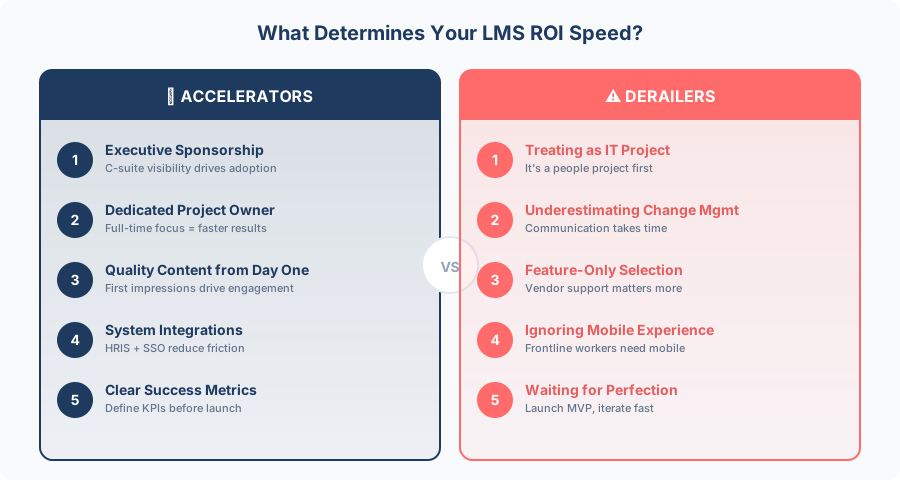
The timeline varies significantly based on organizational factors. Here’s what separates fast implementers from those who struggle:
Accelerators
- Executive sponsorship — When the C-suite visibly supports learning, adoption follows. A CEO who completes courses sends a powerful message.
- Dedicated project owner — Part-time attention yields part-time results. Assign someone accountable for LMS success.
- Quality content from day one — Engaging, relevant courses keep learners coming back. First impressions matter enormously.
- Integration with existing workflows — Connecting the LMS to HR systems, communication tools, and performance management reduces friction.
- Clear success metrics defined upfront — Know what you’re measuring before you start. This makes ROI conversations much easier.
Common Derailers
- Treating the LMS as an IT project — This is a people project with a technology component, not the reverse.
- Underestimating change management — Budget time and resources for communication, training-the-trainers, and ongoing support.
- Choosing based on features alone — The best feature list means nothing if the vendor can’t support your implementation properly.
- Ignoring mobile experience — Frontline workers need mobile-friendly learning. Desktop-only thinking limits reach.
Building Your Business Case
When presenting ROI projections to stakeholders, be conservative and transparent. Here’s a framework:
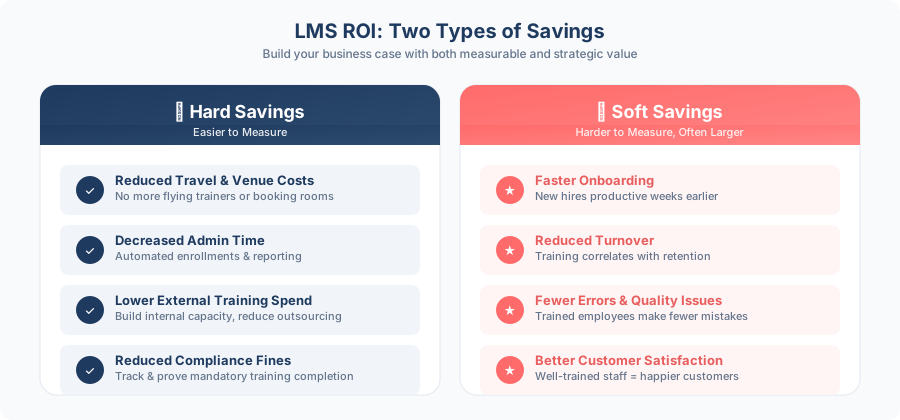
Hard Savings (Easier to Measure)
- Reduced travel and venue costs
- Decreased administrative time
- Lower external training spend
- Reduced compliance violation costs
Soft Savings (Harder to Measure, Often Larger)
- Faster onboarding (earlier productivity)
- Reduced turnover (training correlates with retention)
- Fewer errors and quality issues
- Better customer satisfaction from trained employees
For a deeper dive into why traditional ROI calculations often miss the real value of learning investments, read Beyond the Spreadsheet: Why Most L&D ROI Calculations Miss the Point.
The Bottom Line
An LMS is not an overnight transformation — it is a long-term investment in your people. The organizations that see the fastest ROI share common traits: they plan realistically, resource appropriately, and measure consistently.
Set expectations accordingly. Communicate the timeline to stakeholders before you start. Focus on both efficiency gains (which come first) and performance impact (which comes later but matters more). Most organizations that commit to proper implementation see positive ROI within the first year, with compounding returns as the platform matures.
The question isn’t whether an LMS delivers ROI — the evidence is clear that it does. The question is how quickly you can capture that value, and that depends largely on the choices you make during implementation.
Frequently Asked Questions
How long does it take to see ROI from an LMS?
Administrative savings appear within the first quarter, often a 20–40% reduction in time spent on enrollment, reporting, and training logistics. Most organizations reach full payback within 9 to 12 months, once adoption is steady and performance gains show up.
What is a typical LMS payback period?
For a mid-sized workforce, payback usually lands between 9 and 12 months. The calculator above estimates it from your employee count, training costs, and turnover rate. Lower per-user pricing and faster adoption shorten it.
What delays LMS ROI the most?
Content migration is the usual culprit. Training materials scattered across shared drives and email take longer to move than teams plan for. Weak manager buy-in and the absence of clear learning paths also slow adoption, which pushes results out by months.
How do you measure LMS ROI?
Start with hard savings you can count: reduced admin hours, lower training delivery and travel costs, fewer compliance gaps. Then track performance signals like faster onboarding, lower turnover in roles with structured learning, and error-rate improvements. Connect training data to performance data early so the numbers hold up.
Can an LMS reduce employee turnover?
Structured learning paths tend to lower turnover in the roles that use them, because people ramp up faster and feel supported. In the savings model that retention effect is often the single largest line, though it takes a year or more to show clearly.
Ready to explore what an LMS could do for your organization? Let’s talk.